
Let me tell you something that might sting a little: all those hours you’ve spent cramming keywords into your content? They’re probably wasted if you’re ignoring search intent.
I’ve been in the SEO trenches long enough to watch countless websites pour resources into “optimized” content that goes absolutely nowhere. The reason? They’re answering questions nobody asked, or worse they’re giving the wrong type of answer to the right question.
Search intent is the difference between ranking on page one and shouting into the void. Let’s talk about why it matters and how you can actually use it to dominate your niche.
What Exactly Is Search Intent?
Strip away all the jargon, and search intent is beautifully simple: it’s what someone actually wants when they type something into Google.
Think about it from your own experience. When you search “best running shoes,” you’re not looking for the history of footwear or a philosophical essay on the nature of running. You want recommendations. You want reviews. You probably want to buy something.
But when you search “how to tie running shoes,” you’re in a completely different headspace. You need instructions, probably with pictures or a video.
Same topic. Completely different intent. And if a website shows you product pages when you’re looking for a tutorial, you’re hitting that back button faster than you can say “algorithm update.”
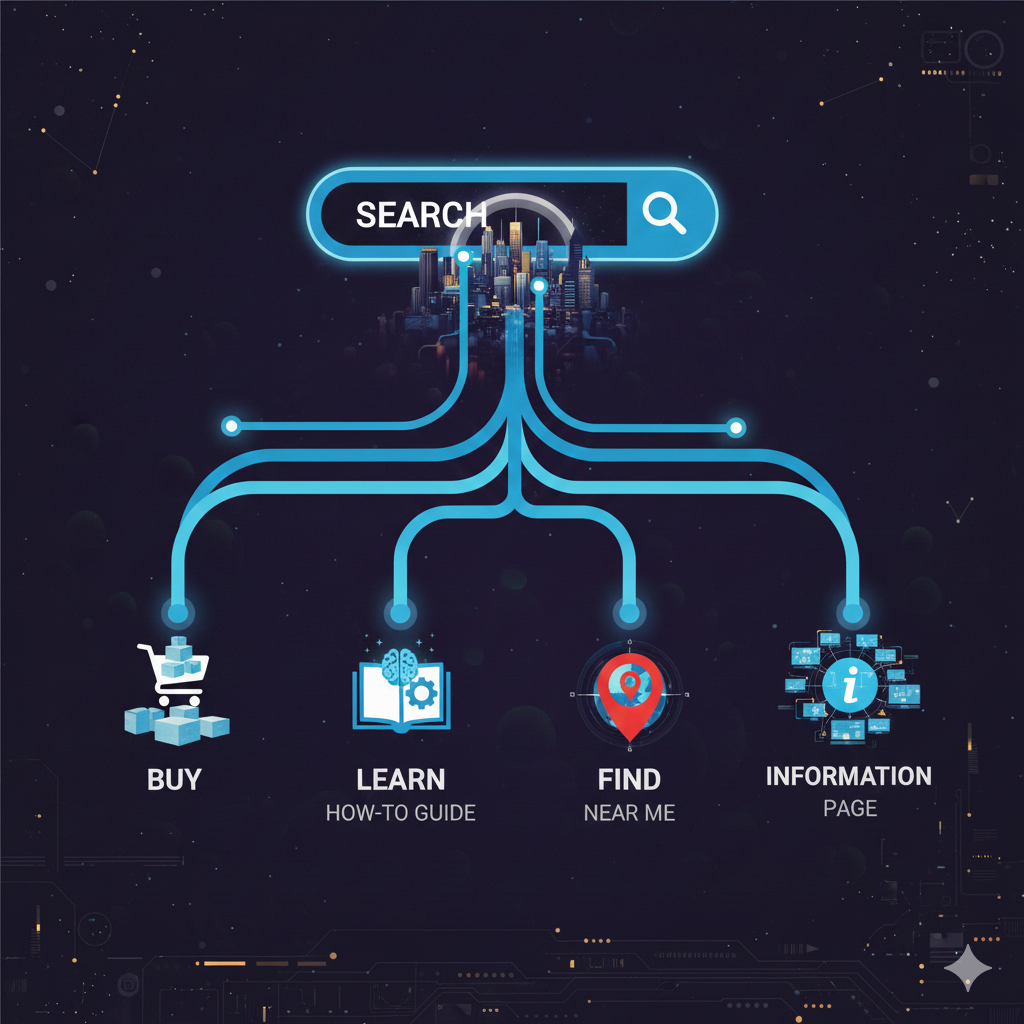
Google knows this. And Google’s gotten scary good at figuring out what you really want, even when your search query is vague or poorly worded.
The Four Flavors of Search Intent
Look, I could overcomplicate this, but there are really just four types of search intent you need to understand. Master these, and you’re 80% of the way there.
Informational Intent: The Learning Phase
This is someone at the beginning of their journey. They’ve got questions, and they need answers. No wallet out yet—just pure curiosity or need-to-know information.
“What is SEO?” “How does photosynthesis work?” “Why is my sourdough starter not bubbling?”
These searchers want blog posts, guides, tutorials, and explainers. They want you to teach them something. The key here is being genuinely helpful without immediately trying to sell them something. Build trust first.
Navigational Intent: The “I Know Where I’m Going” Search
Ever Googled “Facebook” instead of typing facebook.com? That’s navigational intent. The person knows exactly what they want they’re just using Google as their internet GPS.
“Gmail login.” “CNN news.” “Anthropic Claude.”
If you’re not the brand being searched for, forget about ranking here. But if someone’s searching for your brand and they can’t find you? That’s a problem you need to fix immediately.

Transactional Intent: The “Shut Up and Take My Money” Search
This is the golden moment every marketer dreams about. The searcher has their credit card ready. They’re done researching. They want to complete an action.
“Buy organic dog food online.” “Book hotel in Barcelona.” “Download Photoshop.”
These people don’t want another blog post about why they should consider purchasing something eventually. They want product pages, clear pricing, easy checkout processes, and trust signals like reviews and guarantees.
Commercial Investigation: The Smart Shopper Phase
Here’s where it gets interesting. These searchers are close to buying, but they’re not quite ready to commit. They’re in comparison mode, doing their due diligence.
“Best CRM for small business.” “Asana vs Monday.com.” “Is NordVPN worth it?”
They need detailed comparisons, honest reviews, pros and cons lists, and buying guides. They’re looking for someone to help them make an informed decision. Win them over here with genuinely helpful content, and you’ve got yourself a customer.
Why This Actually Matters (Beyond the Buzzwords)
I’m going to be blunt: if you’re not optimizing for search intent, you’re leaving money on the table. Here’s why this isn’t just another SEO fad.
Google Is Intent-Obsessed
Google’s entire business model depends on people finding what they’re looking for. If users constantly bounce back from results because the content doesn’t match their intent, Google looks bad. And Google really, really doesn’t like looking bad.
The algorithm is specifically designed to reward pages that satisfy search intent. You could have perfect technical SEO, lightning-fast load times, and backlinks from every authority site in your niche. But if you’re serving up a product page to someone with informational intent? You’re not ranking. Period.
Your Traffic Quality Skyrockets
Here’s something most people miss: search intent optimization isn’t just about getting more traffic. It’s about getting better traffic.
When someone lands on your page and finds exactly what they were looking for, magic happens. They stick around. They read more. They click through to other pages. They sign up for your email list. They buy your product.
Those positive engagement signals time on page, low bounce rate, pages per session they all feed back into Google’s algorithm. It’s a virtuous cycle: match intent better, rank higher, get more qualified traffic, rank even higher.
You Stop Wasting Time on Content That Doesn’t Work
I’ve seen businesses create dozens of blog posts targeting transactional keywords, wondering why they’re not ranking. Or they’ll build product pages for clearly informational queries and scratch their heads when they’re stuck on page five.
Understanding search intent gives you a roadmap. It tells you exactly what type of content to create for each keyword you’re targeting. No more guessing. No more wasted effort.
How to Actually Do This (The Practical Stuff)
Theory is nice, but let’s talk execution. Here’s how I approach search intent optimization, and it’s simpler than you might think.
Step one: Google your target keyword. I know, revolutionary advice, right? But seriously the search results page is your cheat sheet. Google has already done the hard work of figuring out what users want for that query.
Look at what’s ranking. Are they blog posts? Product pages? Videos? Comparison charts? Take notes.
Step two: Analyze the patterns. If the top ten results are all listicles titled “Best X for Y,” and you’re planning to write a comprehensive guide about the history of X, you’re fighting an uphill battle. Match the format that’s working.
Step three: Look deeper than just the format. Check out the depth and angle of the top-ranking content. Are they comprehensive 3,000-word deep dives, or concise 500-word answers? Are they technical or beginner-friendly? What specific questions are they answering?
Step four: Create something better. Don’t just copy what’s ranking. Use those insights to create content that serves the intent even better. More comprehensive. Better organized. More actionable. More trustworthy.
The Real Talk
Look, I get it. Search intent optimization sounds like more work. Another thing to think about. Another box to check.
But here’s the truth: creating content without considering search intent is like throwing darts blindfolded. Sure, you might hit the bullseye eventually, but you’re going to waste a lot of darts and time, and money in the process.
The websites crushing it in search results aren’t doing anything magical. They’re just giving people what they actually want. They’ve stopped thinking about what they want to say and started thinking about what their audience wants to find.
That’s the shift. That’s the secret.
Start small. Pick your five most important target keywords. Analyze the search intent. Audit your existing content. Does it match? If not, fix it. Then create new content with intent as your north star.
Do that, and I promise you’ll see results. Better rankings. More qualified traffic. Higher conversions.
Because at the end of the day, SEO isn’t about gaming Google. It’s about serving your audience. And search intent is how you do exactly that.